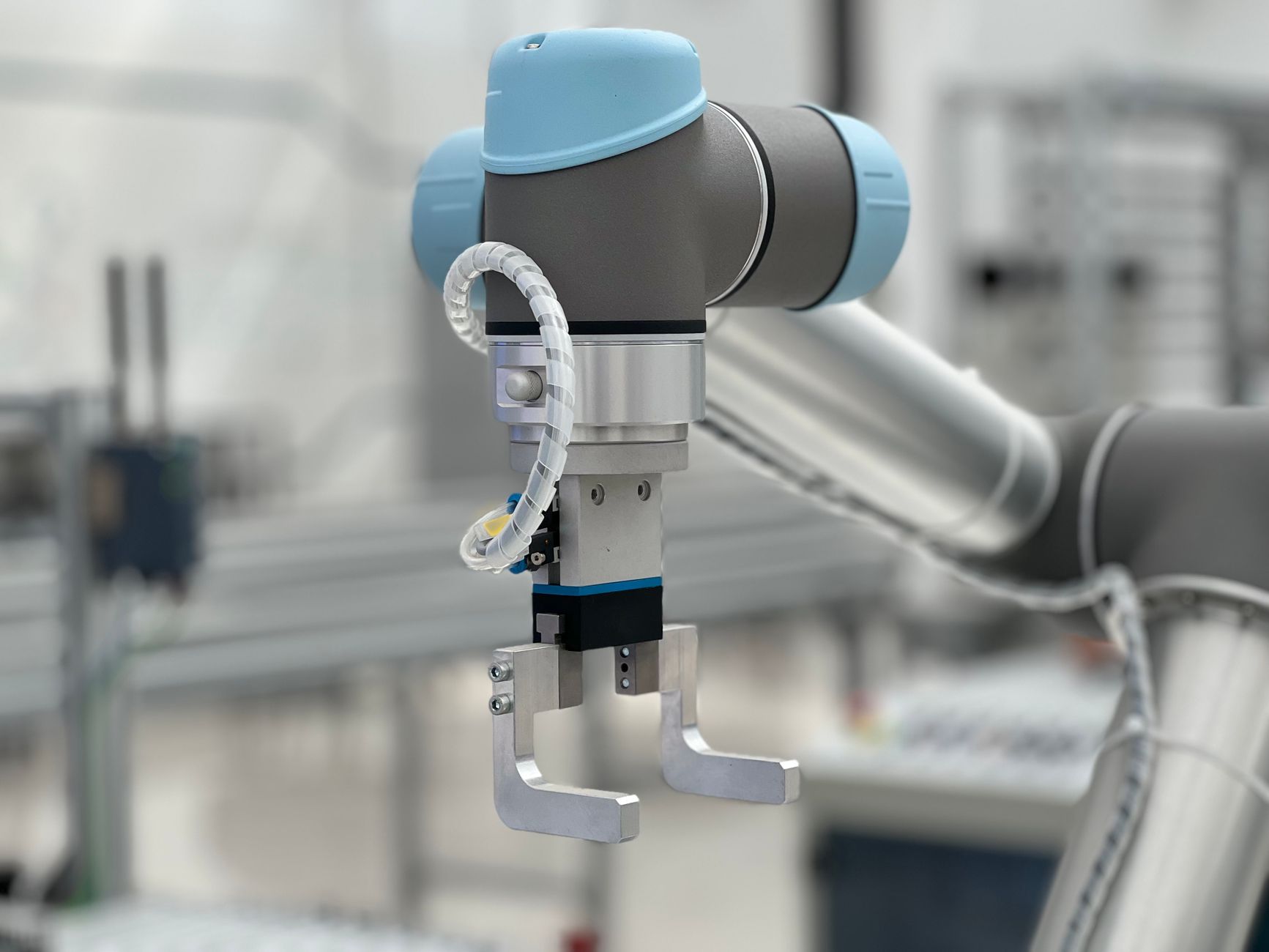
For most of the last decade, the line between “cobot” and “industrial robot” was drawn mostly by payload and speed. Cobots were the small, slow, cage-free arms doing light assembly and machine tending next to a person. Industrial robots were the fast, heavy, dangerous ones behind a fence. That line is getting blurry fast. Universal Robots’ UR30 handles a payload that would have required a mid-size caged robot five years ago. Fanuc’s CRX series now reaches into ranges that overlap with small-to-mid traditional arms. Techman has pushed its heavier models into similar territory. These are still certified as collaborative robots under ISO 10218-1, but they’re doing jobs — and carrying momentum — that used to belong exclusively to fenced cells.
The practical result: more plants are running mixed cells, where a caged industrial robot and a cage-free cobot share a work envelope, a conveyor, or a fixture. That’s not inherently a problem. But it means the safety case for the cell can no longer be “the cobot is collaborative, so we’re fine.” You now have two different risk profiles occupying the same physical space, and the integration has to be assessed as a system, not as two separate machines that happen to be near each other.
The standard just changed under your feet
ISO 10218-1 and -2 got a substantial revision, and ISO/TS 15066 — the technical specification that actually gives you the biomechanical limits for power and force limiting (PFL) applications — remains the reference for quantifying what “safe contact” means. If your cell’s risk assessment predates the current editions, it’s worth treating that documentation as provisional, not settled. The revised standard tightens expectations around risk assessment rigor, application-specific validation, and the documentation trail linking a specific cobot, a specific end-effector, a specific payload, and a specific task to a specific set of validated force and pressure limits.
That last point trips people up constantly. A cobot’s collaborative rating from the manufacturer is not a blanket safety certificate for whatever you bolt onto it. The moment you add a gripper, a tool, or a workpiece with a sharp edge or a pinch geometry, you’ve changed the transient and quasi-static contact forces at the point of impact. ISO/TS 15066’s biomechanical limit tables are body-region-specific — a fingertip, a hand, a forearm each have different pain and injury thresholds — and your integrator or safety engineer needs to re-run those calculations for your actual tooling, not just cite the robot’s factory-default PFL settings.
Where speed-and-separation actually beats a fence
Speed and separation monitoring (SSM), the other collaborative mode under ISO 10218-2 (alongside PFL, hand guiding, and safety-rated monitored stop), uses sensing — typically safety-rated laser scanners or vision systems — to maintain a protective separation distance and slow or stop the robot as a person approaches. It’s the right call in specific circumstances: high-payload or high-speed operations where power and force limiting can’t get you to safe contact forces, but where a hard cage would kill your cycle time or block operator access needed for frequent changeovers.
Where SSM genuinely earns its complexity is a cell where an operator needs intermittent, close access — loading a fixture, clearing a jam, doing a quality check — but the robot itself is moving too fast or carrying too much mass to rely on PFL alone. A hard guard would force a full stop-and-restart cycle every time. SSM lets the robot slow down as the person approaches and resume speed as they clear, without a physical barrier in the way.
Where SSM is the wrong answer: anything where the consequence of a sensing failure or an unanticipated approach vector is severe, and where the operator’s presence pattern is unpredictable. Scanners have blind spots and minimum detectable object sizes. If your risk assessment can’t rule out a person entering from an angle or at a height the sensor doesn’t cover, you haven’t achieved separation — you’ve achieved a false sense of it. In those cases, a fence, or a fence with an interlocked, safety-rated access gate, is still the honest answer, even if it’s less elegant.
What actually has to change in the mixed cell
The part plants underestimate is how much of the fix lives in logic, not steel. Adding a cage-free cobot next to a caged robot usually means your safety PLC’s logic needs new inputs and new interlocks — the cobot’s safety-rated I/O tied into the same safety architecture as the fence’s e-stop and light curtains, so that a breach in either zone produces a coordinated, predictable response rather than two machines reacting independently to the same event.
Concretely, that means:
- Re-mapping the safety-rated monitored stop and SSM zones so the cobot’s slowdown/stop thresholds are synchronized with the caged robot’s e-stop chain — you don’t want the caged robot still moving at speed while a person is standing in a zone the cobot has correctly stopped for.
- Validating that the cobot’s collaborative force/speed limits still hold for the actual end-effector and payload in that specific cell, not the OEM’s generic default profile.
- Re-running the risk assessment as a single combined system under ISO 12100 methodology, with hazard interactions between the two robots explicitly documented — a caged robot’s fence line and a cobot’s SSM zone can create new pinch points or line-of-sight gaps at the boundary between them.
- Confirming the safety PLC’s diagnostic coverage and category/PL (performance level, per ISO 13849-1) rating still meets requirements once you’ve added new safety functions rather than just new hardware.
Some of that is a fence-line change — moving a guard, adding an interlocked gate. A lot of it is not. It’s logic, it’s zone geometry, and it’s documentation that ties a specific tool and task to a specific validated limit. Plants that treat this as purely a mechanical guarding exercise usually miss the parts that actually matter to an auditor or, worse, to an incident investigation.
If your cobot cell was risk-assessed before the current standard editions and before your cobot’s payload or speed changed, the safe assumption is that the paperwork is stale, even if the hardware still runs the same program it always has. Re-running the assessment isn’t bureaucratic overhead — it’s the only way to know whether the “collaborative” label on the datasheet still describes what’s actually happening on your floor.
This article was written with the assistance of artificial intelligence. While we aim for accuracy, the information may be incomplete, out of date, or incorrect, and should be independently verified before you rely on it for any decision. It is provided for general information only and does not constitute professional advice.